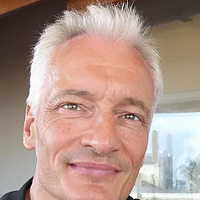
Dirk De Ridder MD, PhD
Neurosurgery
Dunedin, Dunedin, New Zealand
Connect with the speaker?
Prof Dr. Dirk De Ridder obtained his MD at the University of Gent, Belgium, in 1992 and his PhD ('A Darwinian neurosurgical approach to tinnitus') at the University of Antwerp, Belgium. He lived and worked for a year in South Africa, after which he worked for 12 years at the University Hospital Antwerpen in Antwerp, Belgium. He moved to New Zealand in 2013 to become Head of the Neurosurgery Department, where he is currently part time professor of neurosurgery. The rest of his time is dedicated to the neuromodulation Centre BRAIN3N in Ghentm Belgium, which he co-founded, and travelling worldwide for lectures.
His main research topic is the understanding and treatment of phantom perceptions such as pain and tinnitus, as well as addiction, using non-invasive neuromodulation (TMS, tDCS, tACS, tRNS, tPNS, neurofeedback) and especially invasive neuromodulation techniques such as brain implants. The focus of his research is to understand the common mechanisms of different diseases, such as pain, tinnitus, Parkinson’s Disease, depression, slow-wave epilepsy, and a group of diseases known as ‘thalamocortical dysrhythmias’. His research also focuses on addiction, obsessive compulsive disorder, impulsive and personality disorders, and an entity called ‘reward deficiency syndromes’.
He has developed “burst” stimulation, a novel stimulation design for brain and spine implants, which is commercialised by Abbott as BurstDR. He is currently working on other stimulation designs such as noise, infraslow and reconditioning stimulation. The philosophy of these stimulation designs is related to Antoni Gaudí’s adage of mimicking nature, i.e. by mimicking natural firing and oscillation patterns in the nervous system.
Prof Dr De Ridder is recognised as the world-leading expert in tinnitus and pain. He is a strong proponent of interdisciplinary and translational neuroscience. He translates basic neuroscience into novel brain surgery techniques with clinical applications via small pilot studies looking at feasibility and initial clinical results. His interdisciplinary approach is exemplified by the fact that he has published with more than 50 different research groups worldwide.
EVENTS & ACTIVITIES (Speaking, Spoken, and Authored)
International Continence Society (ICS) 46th Annual Meeting
 In-Person Event
 Sep 13 - 16, 2016
 Chiyoda, Tokyo, JP
41st Annual Scientific Meeting of the New Zealand Pain Society (NZPS)
- In-Person Event
 Pain Medicine
- Apr 07 - 09, 2016
- New Plymouth, North Island, NZ
8th ESU Masterclass on Female and Functional Reconstructive Urology
- In-Person Event
- Urology
- Nov 26 - 28, 2015
- Berlin, Berlin, DE
Live surgery from the Radboudumc
- In-Person Event
- Urology
- Sep 10, 2015
- Arnhem, Gelderland, NL

Connect With Us


Awards & Recognitions

- 50 Division Street, Suite 501,
- Somerville, NJ 08876
- support@emedevents.com