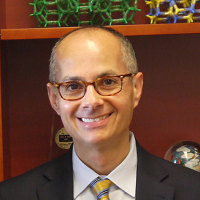
Omar M. Yaghi PhD
Biochemistry and Molecular Genetics
Berkeley, California, United States of America
Connect with the speaker?
Omar M. Yaghi received his B.S. from State University of New York at Albany (1985) and Ph.D. in Inorganic Chemistry from the University of Illinois at Urbana-Champaign (1990). He was an NSF Postdoctoral Fellow at Harvard University (1990-92). He started his independent career as an assistant professor in 1992 at Arizona State University, moved to University of Michigan at Ann Arbor as Robert W. Parry Professor of Chemistry in 1999, and then UCLA in 2006 as Christopher S. Foote Professor of Chemistry and Irving and Jean Stone Chair Professor in Physical Sciences. Since 2012 he has been the James and Neeltje Tretter Chair Professor of Chemistry at the University of California, Berkeley, and a Senior Faculty Scientist at Lawrence Berkeley National Laboratory. He is the Founding Director of the Berkeley Global Science Institute, and the Co-Director of the Kavli Energy NanoSciences Institute, and the California Research Alliance by BASF.
His work encompasses the synthesis, structure, and properties of inorganic and organic compounds and the design and construction of new crystalline materials. He is widely known for the discovery and for pioneering the development of several extensive classes of new materials: Metal-Organic Frameworks (MOFs), Covalent Organic Frameworks (COFs), and Zeolitic Imidazolate Frameworks (ZIFs). These materials have the highest surface areas known to date, making them useful in many applications including the (1) storage and separation of hydrogen, methane, and carbon dioxide, (2) conversion of carbon dioxide to fuels and high-value chemicals, (3) capture of water from air for freshwater production (4) highly selective cleavage of peptides using enzyme-inspired catalysis, and (5) storage of ions in supercapacitor devices, and transport of protons and electrons in conductive frameworks. The building block approach he developed has led to an exponential growth in the creation of new materials having diversity and multiplicity previously unknown in chemistry. He termed this field 'Reticular Chemistry' and defines it as 'stitching molecular building blocks into extended structures by strong bonds'. This chemistry is now being practiced using methods developed by Yaghi since 1995 in hundreds of laboratories in academia and industry worldwide.
His work encompasses the synthesis, structure, and properties of inorganic and organic compounds and the design and construction of new crystalline materials. He is widely known for the discovery and for pioneering the development of several extensive classes of new materials: Metal-Organic Frameworks (MOFs), Covalent Organic Frameworks (COFs), and Zeolitic Imidazolate Frameworks (ZIFs). These materials have the highest surface areas known to date, making them useful in many applications including the (1) storage and separation of hydrogen, methane, and carbon dioxide, (2) conversion of carbon dioxide to fuels and high-value chemicals, (3) capture of water from air for freshwater production (4) highly selective cleavage of peptides using enzyme-inspired catalysis, and (5) storage of ions in supercapacitor devices, and transport of protons and electrons in conductive frameworks. The building block approach he developed has led to an exponential growth in the creation of new materials having diversity and multiplicity previously unknown in chemistry. He termed this field 'Reticular Chemistry' and defines it as 'stitching molecular building blocks into extended structures by strong bonds'. This chemistry is now being practiced using methods developed by Yaghi since 1995 in hundreds of laboratories in academia and industry worldwide.
EVENTS & ACTIVITIES (Speaking, Spoken, and Authored)


Quick Links
Connect With Us


Awards & Recognitions


- 50 Division Street, Suite 501,
- Somerville, NJ 08876
- support@emedevents.com