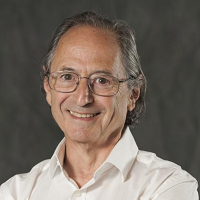
Michael Levitt PhD
Molecular Biology
Stanford, California, United States of America
Connect with the speaker?
Michael Levitt, the winner of the 2013 Nobel Prize in Chemistry, began his theoretical modeling of large chemical systems in 1967, digital computers had only a fraction of the processing abilities they do today. The pioneering work of Levitt harnessed the rapid growth of computational power to create complex multiscale chemical models with a wide range of applications, from the simulation of atomic protein motion to the explanation of enzyme catalysis and protein folding. Join us as Levitt describes computational structural biology’s beginnings and future, as well as how today’s work will inform biomedical and material science applications in the years to come.
Born in South Africa in 1947, Michael Levitt visited London at age 16, where he was profoundly influenced by John Kendrew’s 1944 BBC TV series “The Thread of Life.” After a BSc in London and a year with Prof. Shneior Lifson and his Ph.D. student Arieh Warshel at the Weizmann Institute in Israel, Dr. Levitt joined the Laboratory of Molecular (LMB), Cambridge, in 1968.
Levitt went back to Israel as an EMBO postdoc with Lifson. Collaboration then with Warshel resulted in new multi-scale approaches to molecular modeling: coarse-grained models that merge atoms to allow folding simulation and hybrid models that combine classical and quantum mechanics to suggest enzymes work by electrostatics. In 1974, he returned to LMB for three years, spent two years with Francis Crick at Salk and seven years at Weizmann, before moving to Structural Biology at Stanford from 1987.
Levitt’s diverse interests have included RNA & DNA modeling, protein folding simulation, classification of protein folds and protein geometry, antibody modeling, x-ray refinement, antibody humanization, side-chain geometry, torsional normal mode, molecular dynamics in solution, secondary structure prediction, aromatic hydrogen bonds, structure databases, and mass spectrometry.
Born in South Africa in 1947, Michael Levitt visited London at age 16, where he was profoundly influenced by John Kendrew’s 1944 BBC TV series “The Thread of Life.” After a BSc in London and a year with Prof. Shneior Lifson and his Ph.D. student Arieh Warshel at the Weizmann Institute in Israel, Dr. Levitt joined the Laboratory of Molecular (LMB), Cambridge, in 1968.
Levitt went back to Israel as an EMBO postdoc with Lifson. Collaboration then with Warshel resulted in new multi-scale approaches to molecular modeling: coarse-grained models that merge atoms to allow folding simulation and hybrid models that combine classical and quantum mechanics to suggest enzymes work by electrostatics. In 1974, he returned to LMB for three years, spent two years with Francis Crick at Salk and seven years at Weizmann, before moving to Structural Biology at Stanford from 1987.
Levitt’s diverse interests have included RNA & DNA modeling, protein folding simulation, classification of protein folds and protein geometry, antibody modeling, x-ray refinement, antibody humanization, side-chain geometry, torsional normal mode, molecular dynamics in solution, secondary structure prediction, aromatic hydrogen bonds, structure databases, and mass spectrometry.
EVENTS & ACTIVITIES (Speaking, Spoken, and Authored)
Dural AV Fistula : Diagnosis, Classification, and Management
 Webcast
 Neurology ...
 Dec 21, 2018 - Dec 21, 2021
EMBO Conference - Molecular Machines : Integrative Structural and Molecular Biology
 In-Person Event
- Internal Medicine and General Medicine
- Nov 20 - 23, 2016
 Heidelberg, Baden-Wurttemberg, DE
Quick Links
Connect With Us


Awards & Recognitions


- 50 Division Street, Suite 501,
- Somerville, NJ 08876
- support@emedevents.com