Transcranial Doppler Imaging for Cerebrovascular Disease 2015

 In-Person Event
 Sep 14 - 16, 2015
 Seattle, Washington, USA


OVERVIEW
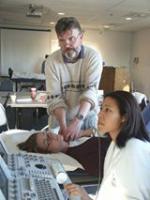
This course is designed for physicians, sonographers, technologists and other health care professionals seeking to acquire the specific skill sets and knowledge base required to perform and interpret Transcranial Doppler (TCD) and Transcranial Imaging (TCDI) studies. In this course, attendees will learn the fundamentals of noninvasive Transcranial Doppler, skills for the interpretation and performance of diagnostic TCD and TCDI through didactic lectures. This knowledge will be reinforced through daily faculty-guided hands-on scanning sessions. Interactive case studies will serve as a basis to further develop of interpretation skills.
Learning will be accomplished through didactic sessions with faculty presenting in those areas of special interest and/or specialization. Lectures will cover the various settings in which transcranial Doppler is performed including the diagnostic laboratory, emergency room, neurosurgical arena, and operating room. Covered applications include: TCD in patients with extracranial occlusive disease, functional vasomotor reactivity testing, monitoring during carotid stenting and endarterectomy, diagnosis of intracranial stenosis and acute intracranial occlusion, diagnosis of vasospasm secondary to subarachnoid hemorrhage, evaluation of stroke risk in pediatric patients with Sickle Cell Disease, evaluation of patients suspected of cerebral circulatory arrest, detection and grading of patent foramen ovale, and more.
The three-day course is held in Seattle University’s Clinical Performance Lab, a state-of-the-art educational facility conveniently located at the acclaimed Swedish/Cherry Hill Hospital campus in Seattle WA. A light breakfast and buffet or boxed lunches are provided daily.
Learning will be accomplished through didactic sessions with faculty presenting in those areas of special interest and/or specialization. Lectures will cover the various settings in which transcranial Doppler is performed including the diagnostic laboratory, emergency room, neurosurgical arena, and operating room. Covered applications include: TCD in patients with extracranial occlusive disease, functional vasomotor reactivity testing, monitoring during carotid stenting and endarterectomy, diagnosis of intracranial stenosis and acute intracranial occlusion, diagnosis of vasospasm secondary to subarachnoid hemorrhage, evaluation of stroke risk in pediatric patients with Sickle Cell Disease, evaluation of patients suspected of cerebral circulatory arrest, detection and grading of patent foramen ovale, and more.
The three-day course is held in Seattle University’s Clinical Performance Lab, a state-of-the-art educational facility conveniently located at the acclaimed Swedish/Cherry Hill Hospital campus in Seattle WA. A light breakfast and buffet or boxed lunches are provided daily.
KEY DATES

14 Sep, 2015
Event Start Date

16 Sep, 2015
Event End Date

SPECIALITIES
RadiologySUGGESTED HOTELS
CONFERENCE VENUE
Seattle Science FoundationRELATED CONFERENCES & LIVE WEBINARS
By Provider Practice Essentials...
Oct 23 - 24, 2026 | Washington, Dist...
State required course for Mississippi
23 CME/CE

By Provider Practice Essentials...
Nov 13 - 14, 2026 | Orlando, Florida, USA
State required course for Mississippi
23 CME/CE
Quick Links